
One standard Windows PC
Use commercial or industrial PCs selected for the target axis count, communication cycle and machine environment.
Software Motion Control
Software motion control assigns dedicated multi-core PC resources to deterministic control. WMX3 runs the real-time motion and fieldbus layers alongside Windows applications, without an NC board or dedicated motion controller.
01 / ARCHITECTURE
The control stack separates ordinary Windows work from deterministic motion while keeping engineering, HMI and machine data on one PC.
Windows applications · HMI · data · engineering
Shared memory and APIs
EtherCAT · CC-Link IE TSN · RTEX · MECHATROLINK
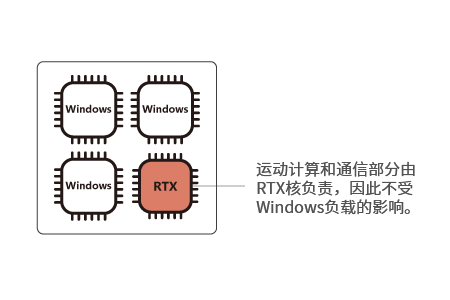
By installing RTX and assigning a dedicated CPU core and memory to software motion control, a Windows PC can provide fast, stable real-time control without interference from ordinary Windows processes.
02 / BENEFITS
Use commercial or industrial PCs selected for the target axis count, communication cycle and machine environment.
EtherCAT connects drives and I/O through standard networking, reducing dedicated boards and field wiring.
Create equipment applications with Microsoft Visual Studio and C/C++ or C# APIs, supported by example programs.
Advanced teams can develop real-time C++ modules and integrate process know-how with the WMX3 motion engine.
Real-time equipment data can be retained in PC memory and used by upper-level applications without a separate gateway.
Different EtherCAT master cycles can share one PC, reserving faster communication for precision axes and longer cycles for transport or auxiliary systems.